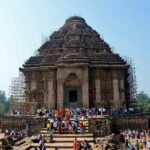
Located at about 35 kilometres northeast from Puri, on the eastern coastline of Odisha (Orissa), is the most famous Sun Temple of Konark.
Also called Surya Devalaya, Surya Deul or the Black Pagoda; the temple was built by the King Narasimhadeva of the Eastern Ganga Dynasty in around 1250 A.D.
Much of the temple is now in ruins, in particular the large shikara tower over the sanctum, that at one time rose much higher than the main mandapa, that remains.
Konark temple was initially built on the sea bank but now the sea has receded and the temple is a little away from the beach. This temple was called the “Black Pagoda” by the European sailors in 17th century, because its great tower appeared black. Similarly, the Jagannath Temple in Puri was called the “White Pagoda”. Both temples served as important navigation landmarks for sailors in the Bay of Bengal.
The name Konark is derived from the combination of the Sanskrit words ‘Kona’ (corner or angle) and ‘Arka’ (the Hindu God of sun). The context of the term Kona is unclear, but probably refers to the southeast location of this temple either within a larger temple complex or in relation to other sun temples on the subcontinent….
The temple follows the traditional style of Kalinga architecture & is oriented towards the east so that the first rays of the sunrise strike the main entrance….
The Konark Sun Temple is built in the form of a giant ornated chariot dedicated to the Sun God, Surya. In Hindu Vedic iconography, Surya is represented as rising in the east and traveling rapidly across the sky in a chariot drawn by seven horses. The seven horses are named after the seven verses of Sanskrit prosody: Gayatri, Brihati, Ushnih, Jagati, Trishtubha, Anushtubha & Pankti !!
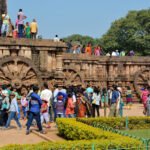
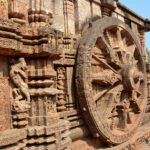
The platform has 24 elaborately carved stone wheels, 12 on each side, giving it an appearance of a grand chariot.
The most popular theory associated with Konark temple is its magnets & the floating idol in the air. The uniqueness of the Sun Temple of Konark lies in the fact that it was built with an architectural setup of various magnets. During the construction of the main tower of the temple the artisans put an iron plate between every two stone pieces. There is a lodestone at the top of the temple was said to be a massive 52 ton magnet……
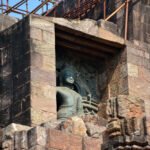
According to legend, the statue of the Sun God inside the temple was built of a material with iron content and was said to be floating in air, without any physical support, due to the unique arrangements of the top magnet, the bottom magnet and the reinforced magnets around the temple walls. The placement of the main temple and the Sun God had been aligned in such a way that the first ray of the Sun from the coast would cross the Nata Mandir (Dancing Hall) and would fall & reflect from the diamond placed at the crown of the Sun God…..
………the magnetic effect of the lodestone was so strong that it caused navigation disturbance in the compasses of the ships which passed by the coast (Konark being a major port at that time). To save their trade and their ships, the Portuguese sailors destroyed the temple and took away the lodestone. One theory states that the removal of the lodestone lead to the collapse of the main temple structure……
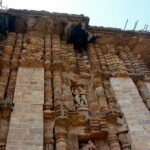
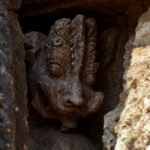
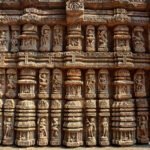
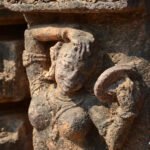
The structures and elements that have survived are famed for their intricate artwork, iconography, and themes…..
……including erotic kama and mithuna scenes.
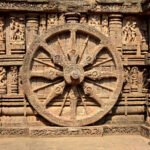
The iconic chariot wheel of the Konark temple…
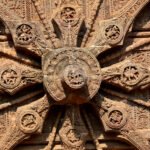
The size of each of the stone carved wheel is 9 feet 9 inches in diameter and each one of them have intricately carved 8 wider spokes and 8 thinner spokes…..
Various theories have been advocated regarding the significance of Konark chariot & its wheels. The 7 horses represent the days of the week and the 12 pairs of wheels represent the 12 months of the year and the 24 wheels signifies 24 hours of a day and the 8 major spokes signifies ‘Prahars’ (three hour period) of a day…..
According to others, the wheels of the chariot have been interpreted as the ‘Wheel of Life’. They portray the cycle of creation, preservation and achievement of realisation…..
The size and architecture of the 24 wheels is same but each one of them has been differently carved all over. The thicker spokes are all carved with circular medallions at their centres on the widest part of the face. The axels of the wheels project out by about one foot from the surface, having similar decorations at their ends. The rims are carved with designs of foliages with various birds and animals, whereas the medallions in the spokes are carved with the figures of women in various luxurious poses, mostly of erotic nature….
The wheels are also sun dials & can accurately show the time of the day.
The vertical axis spokes represent 12 am & 12 pm, while the horizontal spokes represent 6 am & 6 pm. Each of the 8 main spokes are at the 3 hrs mark from the previous one & the smaller spokes divide the 3 hour period (a Prahar) into 90 minutes.
Between the two major spokes, there are 60 beads on the inner rim, each representing 3 minutes interval…
Thus, by keeping a finger at the centre of the axle of the wheel during the day, one can precisely tell the time by its shadow !!!
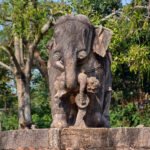
The layer at the bottom of the platform contains friezes of elephants, marching soldiers, musicians, and images depicting the secular life of the people….
The Konark temple is also known for its erotic sculptures of maithunas. These show couples in various stages of courtship and intimacy, and in some cases coital themes.
Konark, also referred to in Indian texts by the name Kainapara, was a significant trading port by the early centuries of the common era….
While there are several theories around how various parts of the temple were destroyed over last 7 centuries; it is evident that if the uncontrolled flow of (mostly) undisciplined visitors is allowed to such monuments, the days are not far when any amount of archeological restoration work will not be sufficient to save these cultural heritages!
We, Indians, are truely blessed to have such archeological marvels. One of the best tributes to these heritage legacies was offered by Shri Rabindranath Tagore, who once said, “Here the language of stone surpasses the language of human”
Konark Sun Temple, Place in my wishlist. I want to visit this place. Only when I have good camera and ample amount of time to explore it well. Will see this blog in free time.
Konark Sun Temple, Place in my wishlist. I want to visit this place. Only when I have good camera and ample amount of time to explore it well. Will see this blog in free time.


















Konark Sun Temple, Place in my wishlist. I want to visit this place. Only when I have good camera and ample amount of time to explore it well. Will see this blog in free time.