Badami, formerly known as Vatapi, is a town in the Bagalkot district of Karnataka, India.
Situated around 650 km south/south east of Mumbai, it was the regal capital of the Badami Chalukyas from AD 540 to 757…..
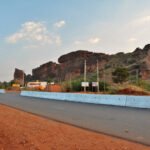
……It is famous for its rock cut structural temples. It is located in a ravine at the foot of a rugged, red sandstone hillock that surrounds Agastya lake.
Lake Agastya. The epic mentions that the wicked asura Vatapi was killed by sage Agastya, and it refers to this area as Vatapi and Agastya Tirtha…….
…..Sage Agastya is described in the epic as a sage with enormous powers of ingestion and digestion. To kill men, asura Vatapi used to become a goat and his brother Ilvala would cook him. Then, Vatapi would recollect in the stomach and tear himself out from the inside of the victim, killing the victim. When Agastya arrives, Ilvala offers the goat again. He kills Vatapi by digesting the meal as soon as he ate, giving Vatapi no time to self organize……what an appetite!!!!
The Badami cave temples are a complex of four Hindu, a Jain and possibly Buddhist cave temples. The caves are considered an example of Indian rock-cut architecture, especially Badami Chalukya architecture, which dates from the 6th century!
The Badami cave temples represent some of the earliest known examples of Hindu temples in the Deccan region…..
The cave temples, numbered 1 to 4 in the order of their creation, are a part of UNESCO-designated World Heritage Site….
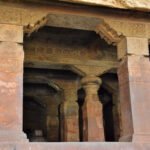
The plan of each of the four caves includes an entrance with a verandah (mukha mandapa) supported by stone columns and brackets, a distinctive feature of these caves….
…..leading to a columned mandapa, or main hall (also maha mandapa), and then to the small, square shrine (sanctum sanctorum, garbha ghriya) cut deep inside the cave.
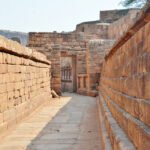
The cave temples are linked by a stepped path with intermediate terraces overlooking the town and lake.
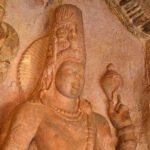
Constructed around 550 CE, Cave 1 is dedicated to Lord Shiv……..
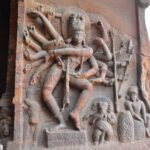
The cave portrays the Tandav-dancing Shiv as Nataraja on the rock face. The image, has 18 arms in a form that expresses the dance positions arranged in a geometric pattern, which depicts the time division symbolizing the cosmic wheel. The eighteen arms express Natya mudras (symbolic hand gestures), with some holding objects such as drums, a flame torch, a serpent, a trident and an axe. Shiv has his son Ganesh and the bull Nandi by his side.
Cave 2 is above Cave 1 and faces north. It was created in late 6th or early 7th century. While it is smaller than Cave 1, it is somewhat similar in terms of its floor plan, but it is dedicated primarily to Vishnu…..
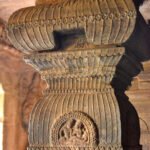
The cave entrance is a verandah divided by square pillars with ends as rounded pillars, all carved out of the monolithic stone face. The pillars have decorative carvings with frieze of ganas (mythical dwarfs)….
The largest relief in Cave 2 depicts the legend of Vishnu in his Trivikrama form, taking one of the three steps. Below the raised step is a frieze showing the legend of Vamana dwarf avatar of Vishnu, before he morphs into the Trivikrama form.
Another major sculpted image shows the legend of Vishnu in his Varah (a boar) avatar rescuing goddess earth (Bhudevi) from the depths of cosmic ocean, with a penitent multi-headed snake (Nāg) below.
The ceiling of Cave 2 shows a wheel with fish spokes in a circular frame. The end bays have a flying couple and Vishnu on Garuda….
Cave 3 is the earliest dated Hindu temple in the Deccan region. It is dedicated to Lord Vishnu; it is the largest cave in the complex…..
The sculptures in Cave 3 is well preserved where Lord Vishnu is presented in various avatars and forms…..
such as seated on the hooded serpent Shesha …….
….standing Narasimha (man-lion avatar)…..
……or as Anantasayana & many more!
Cave 4 is dedicated to Tirthankaras, the revered figures of Jainism. It was constructed after the first three, sponsored by Hindu kings in later part of the 7th-century.
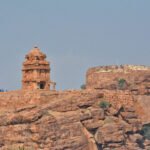
Overlooking the Agastya lake is the Badami Fort. The Badami Fort was the residence of the Chalukyan rulers. The fort was plundered and destroyed by the Pallavas in 642 AD……..
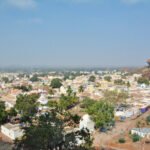
Nestled atop a cliff, the Badami Fort’s location commands a magnificent view of the Badami town and its splendid structures….
Much later, when Badami came under the rule of Tipu Sultan, the walls of the fort were rebuilt and several structures & settlements were added to the ancient fort complex.
Below the Badami Caves & Badami Fort is the Agastya Lake (also referred to as Agastya Tirtha). It is a man made lake, constructed in 5th century & is considered holy due to the healing powers of its water…..
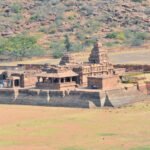
The Bhutanath group of temples is a cluster of sandstone shrines dedicated to the deity Bhutanath, located on the eastern flank of Agastya Lake
There are two major temples here. Temple No.1, on the east side of the lake, called the Bhutanath temple has a superstructure that resembles early South Indian style with its open mantapa (hall or Veranda) extending into the lake…..
The inner shrine and mantapa (hall) of Temple No.1 were constructed in the late 7th century, during the reign of the Badami Chalukyas; while the outer mantapa, facing the Badami tank, was completed during the rule of the Kalyani Chalukyas of the 11th century. Hence the Bhutanatha temple contains architectural forms from different periods.
……. the smaller Temple 2 on the north-east side of the lake, sometimes called the Mallikarjuna group of temples, has a stepped superstructure, commonly found in Kalyani Chalukya constructions
Banashankari temple is a Hindu temple located at Cholachagudd near Badami. The temple is popularly called Banashankari or Vanashankari since it is located in the Tilakaaranya forest.
The temple deity is also called the Shakambhari, an incarnation of the goddess Parvati & it attracts devotees from Karnataka as well as the neighbouring state of Maharashtra.
The original temple was built by the 7th century Badami Chalukya kings, who worshipped goddess Banashankari as their tutelary deity……
The temple was built initially in the Dravidian architectural style & was then rebuilt in the Vijayanagara architectural style. The temple is enclosed by a high wall on all sides & has a square water tank in the forefront of the temple at the entrance, which is locally called as Haridra Tirtha, a corrupted version of the name Harishchandra Tirtha.
Coming up soon – the heritage of Pattadakal & Aihole. Stay tuned!!