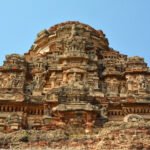
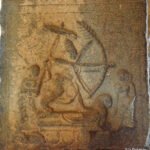
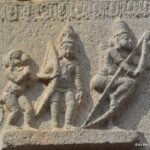
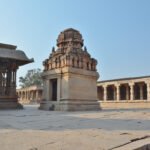
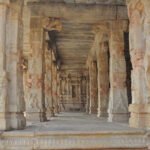
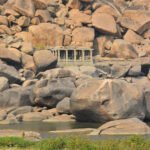
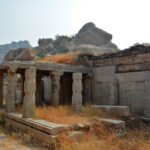
Hampi, also referred to as the Group of Monuments at Hampi, is a UNESCO World Heritage Site located in east-central Karnataka, India; approx 780 km SE of Mumbai & 350 km NW of Bangalore
Chronicles left by Persian and European travellers, particularly the Portuguese, state Hampi was a prosperous, wealthy and grand city near the Tungabhadra River, with numerous temples, farms and trading markets…..
It became the centre of the Hindu Vijayanagara Empire capital in the 14th century. By 1500 CE, Hampi-Vijayanagara was the world’s second-largest medieval-era city after Beijing, and probably India’s richest at that time, attracting traders from Persia and Portugal. The Vijayanagara Empire was defeated by a coalition of Muslim sultanates; its capital was conquered, pillaged and destroyed by sultanate armies in 1565, after which Hampi remained in ruins….
Located in Karnataka near the modern-era city of Hosapete, Hampi’s ruins are spread over 4,100 hectares (41 sq km) and it has been described by UNESCO as an “austere, grandiose site” of more than 1,600 surviving remains of the last great Hindu kingdom in South India that includes “forts, riverside features, royal and sacred complexes, temples, shrines, pillared halls, mandapas, memorial structures, water structures and others”.
Hampi predates the Vijayanagara Empire; there is evidence of Ashokan epigraphy, and it is mentioned in the Ramayana and the Puranas of Hinduism as Pampaa Devi Tirtha Kshetra. Pampa devi refers to Lady Parvati – the wife of Lord Shiv. River Tungabhadra was earlier named as Pampa river!
……However, its fame came from the Kishkindha chapters of the Hindu epic Ramayan, where Ram and Lakshman meet Hanuman, Sugriv and the monkey army in their search for kidnapped Lady Sita!
The armies of the Delhi Sultanate, particularly those of Alauddin Khalji and Muhammad bin Tughlaq, invaded and pillaged South India. The Hoysala Empire & Kampili kingdom in Karnataka was plundered and destroyed in the early 14th century by the armies of Alauddin Khalji & the army of Muhammad bin Tughlaq. In 1336 CE, the Vijayanagara Empire arose from the ruins of the Kampili kingdom. It grew into one of the famed Hindu empires of South India that ruled for over 200 years. The Vijayanagara Empire built its capital around Hampi, calling it Vijayanagara – A site which was multi-religious and multi-ethnic, & fostered developments in intellectual pursuits and the arts.
Vitthala temple and market complex. It is believed that in the market area, lined along side the road (remnant pillars can still be seen), gold & diamonds was sold in open on kg basis!!!
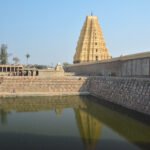
The Vitthala temple and market complex spread over 2 sq km, are near the banks of the Tungabhadra River. In a very typical architectural layout, the road leading to the main temple has water storage arrangements in the form of stepped pond – called Pushkarini.
The Vitthala temple, is the most artistically sophisticated Hindu temple in Hampi, and is part of the sacred centre of Vijayanagara. Believed to be built around early 16th century, the temple was dedicated to Vitthala, a form of Krishna also called Vithoba.
Inscription of images of devotees doing a Sashtaang Namaskaar or Dandavat Pranaam (by lying fully prostrate on the floor with their arms stretched out towards the Idols) at the entrance of the temple
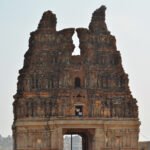
The temple opens to the east, has a square plan and features an entrance gopuram with two side gopurams. The main temple stands in the middle of a paved courtyard and several subsidiary shrines, all aligned to the east…..
The courtyard’s ornate stone chariot (illustrated on the new ₹50 note) is the temple’s showpiece and represents Vishnu’s vehicle with an image of Garuda within. This Garuda shrine in the form of a stone chariot is also a pictured symbol of Hampi. The wheels of this towered shrine were once capable of moving. Also the elephants in the front were not the original animals. The chariot was originally pulled by horses, which were damaged & were replaced by elephants.
The Garud Shrine
Lord Vishnu in its Garud-avatar
This dotted border is not just for its decor! It is a marvel of engineering design! The granite stone used, has a lot of iron in it. Thus for it not to get rusted & spoil the sculptures with its red tinge, these inverted domes acts as water channels for the rain water to drip as droplets, directly onto the ground & not seep into the carvings, spoiling it!
In the front of the stone chariot is a large, square, open-pillared, axial sabha mandapa, or the community hall. This Mandap is believed to have a wooden roof, which was either destroyed by the invaders or was lost in natural calamities.
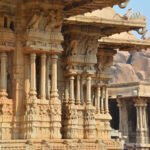
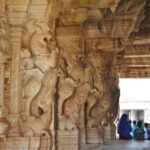
The large Ranga Mantapa is well known for its 56 musical pillars. These pillars are also known as SaReGaMa pillars, which are attributed to the musical notes emerging out of them. The musical notes can be heard when the pillars are gently tapped.
The mandapa has 56 carved stone beams of different diameters, shape, length and surface finish that produces musical sounds when struck…..
Each pillar is ornated with a statue of lady playing a specific musical instrument…..
……which is supposedly designed to replicate 81 different Indian instruments, reverberate when tapped…. Amazing, isn’t it?
The platform of the temple is ornated with sculptures depicting the daily life in Vijayanagar empire…..
frescos & painted ceilings of the temple
….horse traders in the bazar, selling the horses…..
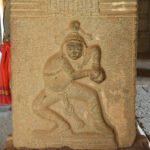
…wrestlers entertaining the common people….
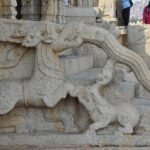
or the illusion sculptures like this – Is it a bull or an elephant?
Influence from the Eastern cultures – A dragon spitting fire!!
Utsav mandapa (festival hall) in the courtyard of the temple
The Kalyan Mandapa (the wedding hall, on the right)
The temple also has various scenes depited from the epics and puranas. Kaamdev shooting the arrow of desire….
The scene of Lord Krishna climbing up the tree, playing with the Gopis
Narsimha & Hiranyakashyapu story
The early scripts on the walls of the temple
The temple also has quite a bit of Ramayan stories depicted on its wall. This one is Ram killing the golden deer & the demon Marich coming out of the body of the deer. Can you see the deer head falling off?
The scene of duel between Sugriv & Vaali
Ram, Lakshman & Hanuman
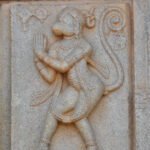
Hanuman sitting on his coiled tail (to raise himself to the level of Raavan) in Lanka
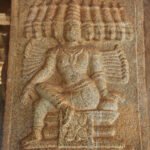
Raavan. Look at the intricacy of the carving!!
While the Vitthala Temple does not have any deity or idol inside the main sanctum…..
…..it is believed that the main idol of this temple (Vitthala or Vitthoba), was moved from here to the Pandharpur’s famous Vitthoba Temple during 17th century!!
Queen’s Bath – This is the first ruined structure you would see when you enter into the Royal center area of Hampi. The whole building is made with a veranda around facing a big open pond at the middle. Projecting into the pond are many balconies. An aqueduct terminates in the pond.
The balconies are decorated with tiny windows and supported by lotus bud tipped brackets. The whole pool is open to the sky. This brick lined pool is now empty. But it’s believed that once fragrant flowers and perfumed water filled this bathing pool. At one end of the veranda you can see a flight of steps giving access to the pool. The domical roof of the veranda is a spectacle in itself.
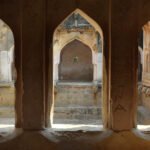
Square in design and with a plain exterior, the interior is a surprise with extremely pretty internal arcades and ornate balconies that would have looked over the water that once filled the central area of the building. Traces of original plaster work still survive, as does sadly quite an extensive array of more modern graffiti.
The Royal Enclosure
Another engineering marvel of Vijaynagar engineers was the method to cut the stones. The stones were marked with such small holes. Bamboo shoots were affixed in each of these holes & were watered. Bamboo shoots will swell with water, causing the stone to crack at precise position !!!
The entrances were guarded by such heavy stone gates with the pivot mechanism.
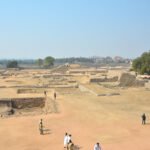
The royal enclosure in Hampi was the Vijayanagara kingdom’s seat of power. In its prime, it housed as many as 45 buildings including the durbar halls, platform, tanks, underground chambers and temples. There are three entrances to the Royal Enclosure; two in the north and one in the west…..
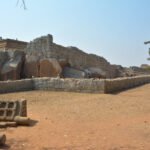
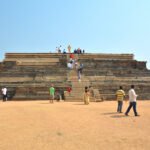
The Mahanavami platform, also called the “Great Platform”, “Audience Hall”, “Dasara” or “Mahanavami Dibba” monument – Is the largest monument in this complex. It has three ascending square stages leading to a large, square platform that likely had a wooden mandapa above it. The mandapa was burnt down during the destruction of Hampi….
The two lower levels of the platform are made of granite. It has reliefs—possibly a catalogue of 14th-century royal activity…..
….and lines of marching animals including elephants, horses and camels….
Three headed clown with just two pairs of leg.
South of the platform is an aqueduct leading water to large, symmetrical, stepped tank made of granite that was excavated by archaeologists in the 1980s…..
….This aquaduct would fetch water from the nearby water reservoirs & lakes & feed the smaller tanks within the Royal Enclosure via gravity flow!!!
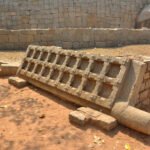
The granite plates for meals.
Excavations in the 1980s near the Mahanavami platform in the urban core of the Royal Enclosure revealed a large, square-stepped tank that was fed by an aqueduct…..
This 5 tiered stepped tank is one of the most well-preserved structures in the Royal Enclosure, that covers an area of 22 square meters and has a depth of 7 meters.
It is believed that each of the steps of this tank were sculpted at different places & were broght here & “assembled” into a tank. This is evident from the names & numbers carved on each step.
The tanks were mainly public utilities, some were perhaps used for royal ceremonies
The Hazaar Rama Temple
The Hazara Rama temple, referred to as the Ramachandra temple in inscriptions, occupied the western part of the urban core in the Royal Enclosure section of Hampi
The temple has an entrance mandapa and a yajna ceremony hall. Inside the main mandapa are four intricately carved pillars in the Hoysala style; these carving include depictions of Rama, Lakshmana and Sita of Vaishnavism, Durga as Mahishasuramardini of Shaktism and Shiva-Parvati of Shaivism
The inner walls of the temple has friezes containing the most extensive narration of the Hindu epic Ramayan….
The scenes of Ramayan are spread in three bands across the inner walls of the temple. Thus one needs to do three parikrama of the temple in clockwise direction to compleletely read the story!!
The story sculptures begins here when King Dashrath performs the Putrakameshthi Yagya & distributes the nectar to his three queens, Kaushalya, Kaikeyi & Sumitra…depicting the birth of the 4 princes – Ram, Bharat, Lakshman & Shatrughna
Killing the demon, Raavan. His 10 heads were chopped off by the arrow of Ram
….and ends with Vibhishan, the brother of Raavan with Ram, near the deathbed of Raavan
King Dashrath sitting with his 4 daughters
The temple’s outer walls portray other Vishnav sculputres depicting Lord Krishna in various forms – be it playing flute with the Gopikas around him…..
…or the scene of Kaliya daman….
…..or as Garudavtar lord Vishnu
The deep Stambh or the Lamp Pole in Royal Enclosure
The Zenana enclosure, meaning Ladies enclosure lies within the Roayl Enclosure section of hampi
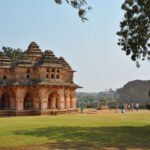
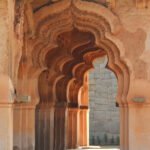
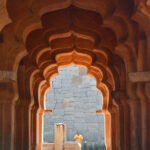
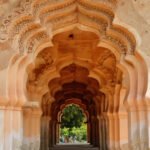
The Zenana enclosure contains the Lotus Mahal, a two-storeyed pavilion that combines a symmetrical, square, Hindu mandala design with lobed arches, vaults and domes of the Indo-Islamic style
The Lotus Mahal and other structures in the Hampi urban core, however, were not built with Muslim patronage. Instead these buildings reflect the assimilative and inclusive approach of the Vijayanagara Hindu rulers, to all religions & art forms.
The beauty of Lotus Mahal is in its Airconditioning system…..
The ceilings of Mahal had an intricate labrynth of clay pipes, through which the water was being cirulated in summer days. Combined with the tall ceiling structures & ventilation on the top, the cumulative effect was that of an air conditining in summer days.
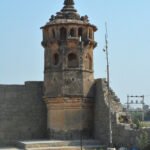
One of the three watch towers to keep an eye on the intruders in & around Ladies enclosure.
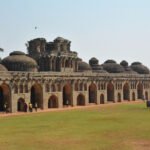
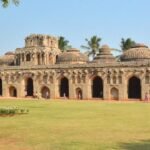
The Gajashala, or the elephant stables
It consist of eleven square chambers that housed royal elephants of the Vijayanagara Empire.
The elaborate structure indicates the importance attached to the royal elephants during those days & is a finest examples of Indo-Islamic style of architecture
The building has a row of eleven huge domed chambers, each of which is large enough to accommodate an elephants at a time. The domed chambers are interconnected with large arched openings….
The uniqueness about the elephant stable is that it has a distinct central dome. The central dome is the largest and most decorated among the 11 domes of the building. The design of the central dome represents the Hindu architectural style found in the temples of Hampi……..
….where as the other 10 domes represent the Islamic style of architecture. The domes of the building were designed in a variety of shapes, such as, octagonal, circular, ribbed, drum-shaped and fluted!!
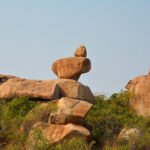
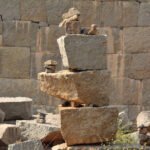
From the creation of nature, balancing the rocks………
…..to the creation of humans, mimicking the natural formations found in Hampi!!!
MIrchi Vada…..a delicacy of local chilly variety, deep fried in chickpea flour coating. It may look scary……but it was yummylicious!!!
Virupaksha Temple
The Virupaksha temple is the oldest shrine, the principal destination for pilgrims and tourists, and remains an active Hindu worship site. It is believed to be dated as old as 7th century. The temple faces eastwards, aligning the sanctums of the Shiva and Pampa Devi temples to the sunrise; a large gopuram marks its entrance. The superstructure is a pyramidal tower with pilastered storeys on each of which is artwork including erotic sculptures…..
The gopuram leads into a rectangular court that ends in another, smaller gopuram dated to 1510 CE. To its south side is a 100-column hall with Hindu-related reliefs on all four sides of each pillar.
Krishnadevaraya, one of the famous king of the Vijayanagara Empire was a major patron of this temple. The most ornate of all structures in the temple, the central pillared hall is believed to be his addition to this temple….
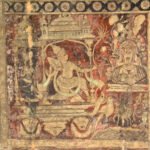
The central pillar hall to the temple holds numerous ceiling frescos, depicting the story of the life of Lord Shiva & Lady Parvati…..
….from Shiva Parvati’s wedding….
…to Shiva fighting the demons on the chariott of sun…..
…to the misadventure by Kaamdev that led Shiva open his third eye….
….to Brahma Vishnu & Mahesh…..
….& many more!!! The whole mandapa ceiling is ornated with these wall paintings which are surprisingly still well maintained.
The temple is located on the banks of Tungabhadra river…..
A narrow channel of the Tungabhadra River flows along the temple’s terrace and then descends to the temple-kitchen and out through the outer court. Another classic example of engineering marvel by the King Krishnadevaraya
The stones in the river has sevaral intrtricate carvings.
…to Shivling
The Anjaneya Hill in Anegundi, is considered to be the birth place of Lord Hanuman and houses a very beautiful Hanuman Temple on top of the hill, also known as Anjana Matha Temple or the Anjaneya Temple. The hill has around 570 steps & a steep climb to reach the temple. THe view from the top of this hill is breathtaking, as one can see entire Hampi city.
The picture of devotion!!
Hampi has two prominant Ganesh temples. The Kadalekalu Ganesh is one of the largest statues of Lord Ganesh that exists in the southern part of India. The temple houses a remarkable monolithic statue of lord Ganesh. The other one, located a few meters away from this one is the Sasivekalu Ganesh Temple – containing a comparatively smaller idol.
View of Hampi city form the Hemakuta hills
The Krishna temple, also called Balakrishna temple, on the other side of Hemakuta hill, & is dated 1515 CE…..
The inscription of Lunar Eclipse on the ceiling of the door frame of the temple.
The original image of Balakrishna (baby Krishna) in its sanctum is now located in Chennai museum
In front of the ruined temple is a long market street, also referred to locally as the Krishna bazaar……
Between the stone pillared shop ruins, is a broad road that allowed chariots to transport goods to and from the market, and hosted ceremonial functions and festive celebrations.
Inscription of a maid removing thorn from the feet of a female warrier.
South of the Krishna temple’s exterior are two adjacent shrines, one containing the largest monolithic 3 meter tall Shiva Linga…..
…..& the other with the largest monolithic, 6.7 meters tall Yoga-Narasimha avatar of Vishnu in yoga position
The Narasimha monolith originally had goddess Lakshmi with him, but it shows signs of extensive damage and a carbon-stained floor—evidence of attempts to burn the shrine down. The statue has been cleaned and parts of the shrine have been restored
The escavation in Hampi still continues & the archeologists still find newer relics or remnants of civilization, every now & then. This discovery was of a water canal, lined with granite dishes for meals…..
Terracota pipes & water supply systems….
The Kamalapura lake is believed to be built by Krishnadevaraya as a water supply reservoir away from the city.
These aquaducts are believed to have a labrynth below the city of Hampi to carry freshwater from that lake.
The hampi bazar & the virupaksha temple
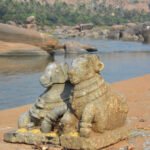
Locally known as Yeduru Basavanna or Nandi, this monolithic bull marks the east end of the Virupaksha Bazaar. The statue, almost 5 meters tall, is housed in a twin storied pavilion built on an elevated platform. A heap of gigantic boulders behind the pavilion offers an interesting backdrop.
Achyutaraya Temple
Hampi has sevaral ruined temples spread across the city & on both sides of the river. A few are prominant ones, where as most of them are inconspicuous ones!
Climbing the flights of steps behing the Monolithic nandi statue takes you to a very interesting part of Hampi…..the riverside walk!
walking alongside the manmade & natural wonders, the river route connects Virupaksha temple with the backside of the Vittala Temple…..
Another interesting piece of history behind the Vittala Temple is the Kings Balance. Survived only by its arch now, balance is also called as Tula Bhara or Tula Purushadana. The King used to weigh himself with gold, gems, silver and precious stones, and distributed to the priests, especially during the eclipse days.
Another fascinating ruin temple from Hampi is the Malayavanta Raghunatha Temple……
….located on the famous Malyavanta Hill….
It is believed that Rama and Lakshmana stayed here till the monsoon rains were over & worshipped Lord Shiva, before marched to Lanka along with the monkey army of Hanuman!!
Today this place is still used for social functions, including weddings in its Kalyana Mandapa.
Hampi is not just a city…its a saga of India from 7th century tio 16th century…its a reflecton of the propserity in which the Indian civilisation once lived, before being pounded & looted by the Mughals…..its an epic depicting the glorified yesteryears of this land. We see the grafitised walls of the sacred temples & hear about some unfortunate incidences of people vandalising this cherished treasure. If this continues that we would be the biggest culprits of depriving our next generations of the glimpses of our culture….our sanskriti!