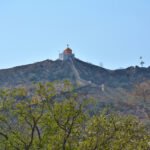
According to legend, Kutch was ruled by the Naga chieftains in the past. Sagai, a queen of Sheshapattana, who was married to King Bheria Kumar, rose up against Bhujanga, the last chieftain of Naga…..
After the battle, Bheria was defeated and Queen Sagai committed sati. Named after the chieftain, Bhujanga, the hill where they lived, was named as ‘Bhujia Hill’ or ‘Bhujiyo Dungar’ …..
…….and the town at the foothill was named as “Bhuj”.
Fortification of the Bhujiya hill occured during Deshalji-1’s reign (1718–1740). Bhujang was worshiped by the people as snake God (Sanskrit – Bhujanga), and a temple was constructed atop the fort to revere him.
The city of Bhuj was founded by Rao Hamir in 1510 and was made the capital of Kutch by Rao Khengarji I in 1549. Eversince, Bhuj has seen several invasions by the Mughals….some successfully defended, some lost! On 26th March 1819, the city of Bhuj was captured by the British. After the independence of India in 1947, Kutch State was formed, which, in 1956, was ultimately merged with the State of Bombay (In 1960, the State of Bombay was divided into Gujarat & Maharashtra). Kutch ultimately became a part of Gujarat state as Kutch district & Bhuj was named the district headquarters of Kutch District, the largest district in India!
On the 26 January 2001, the city suffered great losses of life and property due to a devastating earthquake. Many parts of Bhuj were demolished due to the extensive damage, whilst the others were repaired. There has been great progress in rebuilding the City since the 2001 earthquake, with considerable improvements to roads, transportation, and infrastructure !!!
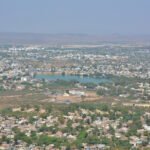
The iconic Hamirsar Lake, is a man made lake situated in the centre of Bhuj city. The lake, which has become the ‘identity’ of Bhuj, is 450 years old, named after Jadeja ruler Rao Hamir, the founder of Bhuj……
The lake was built during the reign of Rao Khengarji I, who named it after his father Rao Hamir. Khengarji chose this place as an oasis in saline and arid Kutch; and over several decades, developed canals and tunnels to bring together water from three river systems and recharge acquifier, to fulfill the water needs of Bhuj…..
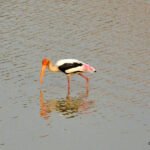
The lake is spread over an area of 28 acres and has a beautiful mid-lake garden. Several species of migratory birds are seen here during the winter months!
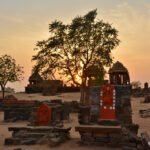
Close to the Hamirsar lake is a place, named “Chaatedi”……
While, not much information is available about this place, the name is derived from the word ‘Chhatri’, the coloquial reference to the Umbrella shaped Domes, over these monuments….
Spread across a vast parcel of land, Chaatedi is believed to be the funeral place for Maharajas of Kutch……
The structures are believed to be the Tombs of the Rulers!
2001’s earthquake has caused extensive damage to the structures…..
….but the glory of this place is intact!!!
If one really wishes to see how these magnificent structures looked before the earthquake, see the movie – Hum Dil De Chuke Sanam…..
Some of the classical theme based songs of that movie are shot here & it captures the glorious days of Chhatedi!!!
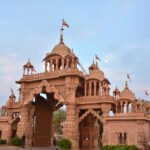
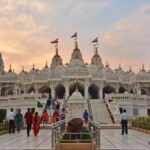
Bhuj is home to one of the first Swaminarayan Sampraday temples, built in 1822…..
While the earthquake damaged the old temple (which is still existing in Bhuj), a grand new temple was built post 2001 at a different site.
Bhuj is famous for its historic crafstmanship of the Kutch region, including the textile crafts of bandhni (tie-dye), embroidery, and leatherwork. A small town just 8 km southeast of Bhuj called Bhujodi is a major textile center of Kutch, with the vast majority of the inhabitants involved in various handicraft production. Here you can meet weavers, tie-dye artists and block printers, most of whom belong to the Vankar community….
No…its not Delhi !!! The Vande Mataram park created in Bhujodi, houses the replicas of some of India’s most prominent buildings. This Parliament house, is not just a replica, but is also a theatre for the light & sound show, showing Indian independence struggle!
What more can you ask for, in the afternoon heat of the desert? A local ice cream truck, with the local varieties of Ice creams, Kulfis & Milk Shakes!!!
The ‘Durbargadh’ or the ‘Palace Complex’ is one of the key attractions in Bhuj…..
Its construction was commenced by the prince of Kutch in 1548 & several newer structures were added to it over several centuries, reflecting the artistic and cultural development of the city……
Some of its intricate carvings & designs are breathtaking!!!
However, it is believed that the Darbargadh’s most significant interiors and structures date from the 18th & 19th centuries…….
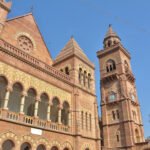
…one of such prominant structures within the Darbargadh complex is the Prag Mahal….
Named after Rao Pragmalji II, the palace contruction began in 1865 under the architectural supervision of a British architect, Colonel Henry Saint Wilkins.
It was designed in the Italian Gothic style & many Italian artisans were involved in its construction. The construction, which ultimately cost 3.1 million rupees, was completed in 1879
This is the first building in India to adopt the Neo-Gothic architectural style, which were then followed by many more, especially in Mumbai!
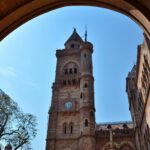
The most interesting element of Prag Mahal is its 150 ft tall ‘Bing Bang’ clock tower, that dominates the skyline of Bhuj….
It is pertinent to note that there are only two such towers in India – one in Bhuj & other in Mumbai – the Rajabai Tower at the Mumbai University!!
The Clock tower is one of the prominant landmarks of Bhuj, which can be seen from any part of the city. It overlooks the Bhuj skyline. Can you see the Bhuj Fort???
The 2001 earthquake severely damaged the palace & the Darbargadh structures. In 2006, the palace was burgled & antiques worth millions were lost. Today, however, the palace and the tower have been mostly repaired, are now open for public viewing. However, the restoration work is still ongoing!
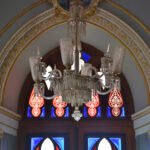
The Aina Mahal is an 18th century palace located next to the Prag Mahal in the Darbargadh complex….
Built by Rao Lakhpatji in 1761, it houses several typical Royal court areas like the Music room…
the armory…..
the painting room….. (this is a glass paininting, which has been painted from inside the glass!!)
& the court room!
The walls of the palace are of white marble covered with mirrors separated by gilded ornaments with shades of Venetian glass
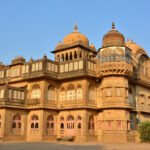
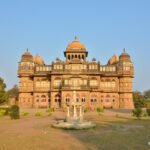
Located at around 40 km from Bhuj, at the sea beach of Mandvi, is the magnificent Vijay Vilas Palace….
The palace was built during reign of Maharao Shri Khengarji III, the Maharaja of Kutch, as a summer resort for the use of his son – Vijayaraji – hence the name. Completed in year 1929, the palace is built with red sandstone & has all the elements of Rajput architecture and draws largely on the plan of palaces of Orchha and Datia. The current generation of the Royal family of Kutch, still uses this as their residence, when they are in Kutch.
Mandvi Beach
Mandvi was once a major port & thus has a 400 years old ship building industry, which was started by the caste of Kharva.
Another key attraction near Mandvi is the 72 Jinalaya or the Boter Jinalaya. It is a Jain Temple, built in octagonal shape with 72 Deris or small temples of Jain Tirthankars.
While Kutch is a desert region, mostly having hot climate with super arid conditions….it is a cultural & heritage rich society, with very kind & helpful people…..
……whose warm hospitality, friendliness & the simplicity of lives, touches your heart & wins your souls…..